What This Post Delivers#
What if everything you’ve learned about trading is actively preventing your success? Most traders are trapped in an endless cycle of chasing indicators, buying “proven” systems, and studying price charts—only to watch their accounts slowly bleed out. Why?
Because they’re solving for the wrong equation.
This isn’t another “trading secrets” article. It is an intervention. We’re dismantling the three core illusions that ruin traders, replacing them with the pillars professionals actually rely on:
- The illusion of “Market Mastery” - Why complex analysis often distracts you from actual market structure and price action.
- The illusion of Certainty - And the critical mental pivot to probability thinking that transforms volatility into your edge.
- The illusion of Control - How hidden risk management flaws and poor position sizing can liquidate you while you’re winning.
We’ll connect these into a single, actionable framework. This is trading stripped of illusions, built for the chaotic, probabilistic reality of actual markets—where position sizing and disciplined execution determine survival. The alternative is continuing what hasn’t worked.
Introduction: Why Most Traders Fail Before They Begin#
The statistics are brutal: approximately 90% of retail traders lose money. The common narrative blames emotions, lack of discipline, or bad luck. But this is a surface-level diagnosis. The root cause is a structural failure in their approach.
Most newcomers are sold a fantasy: that a specific pattern or oscillator will unlock predictable profits. They focus entirely on entry techniques, neglecting the ecosystem in which those entries exist. This is like learning to fire a rifle without understanding wind, gravity, or the nature of your target. You might hit something occasionally, but you’ll never be a sharpshooter.
True trading competency is built not on a single skill, but on a tripod of understanding:
- Pillar 1: Market Mastery – Understanding what you are trading and how it actually moves.
- Pillar 2: Probability Thinking – Internalizing the uncertain nature of all market outcomes.
- Pillar 3: Risk Management – Implementing the rules that ensure you survive the uncertainty long enough to win.
Remove one leg, and the entire structure collapses. This post will build your foundation, pillar by pillar.
Pillar 1: Market Mastery – Beyond Lines on a Chart#
Market Mastery isn’t about memorizing every candlestick pattern. It’s about developing a cohesive theory of how and why price moves in your chosen arena (stocks, forex, crypto). It’s the “edge” in your trading.
1.1 Understanding the “Market Ecosystem”: From Catalyst to Price Print#
Price on your screen is the last step in a long chain of events. Trading blindly off that price is like diagnosing an illness by looking only at the fever. You must understand the sequence which is as follows:
[Macro/Fundamental Catalyst] → [Institutional Interpretation & Order Flow] → [Liquidity Imbalance & Market Microstructure] → [Price Movement & Volume] → [Technical Patterns Form] → [Retail Reaction & Sentiment Shift]
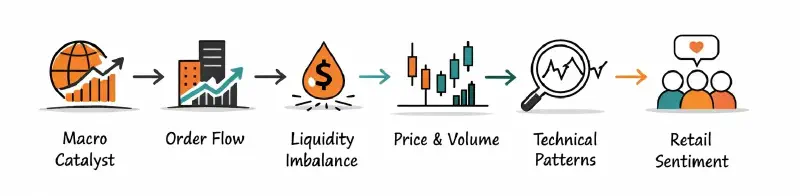
- Classical Technical Analysis (patterns, indicators) primarily studies the fifth stage—the footprints left by the process. It’s useful, but lagging.
- Modern Order Flow Theory (often called “Smart Money Concepts,” ICT, or Price Action) attempts to model the second and third stages—where institutional activity creates imbalances. This is crucial for understanding why a support level might hold or break.
The Synthesis: Use higher-timeframe classical TA (weekly/monthly support/resistance) to identify the theater of operation. Then, use order flow concepts (liquidity pools, order blocks, imbalances) to identify likely points of action within that theater.
1.2 A Realistic Map of Market Theories#
Not all theories are created equal. Here’s a pragmatic breakdown:
| Theory Category | Core Premise | Best Use | Key Pitfall |
|---|---|---|---|
| Classical TA (Patterns, Indicators) | History repeats via crowd psychology. | Identifying high-probability zones and overall trend structure. | Lagging, prone to false signals in choppy markets. |
| Order Flow / Market Microstructure | Price is driven by institutional liquidity needs. | Timing entries/exits and understanding intraday volatility. | Can become overly complex; beware of guru “magic bullet” narratives. |
| Wave & Cycle Theories (Elliott, Harmonics) | Markets move in natural, fractal rhythms. | Identifying potential major reversal zones when combined with other tools. | Extreme subjectivity. The count is often clear only in hindsight. |
| Sentiment & Behavioral Analysis (COT, Put/Call) | Markets are driven by crowd psychology extremes. | Contrarian signals to identify unsustainable greed or fear. | Terrible for timing. Extremes can last much longer than expected. |
The Takeaway: Don’t swear allegiance to one dogma. Market Mastery is eclectic. Build a primary framework (e.g., Order Flow for timing + Classical TA for zones) and use other theories as secondary filters. Your goal is to answer: “What is the market most likely doing right now, and what would prove me wrong?”
Pillar 2: Probability Thinking – The Heart of the Professional Mindset#
This is the mental model shift that separates amateurs from professionals. Markets are not predictable; they are probabilistic.
2.1 The Fat-Tail Reality: Why “Normal” Stats Lie#
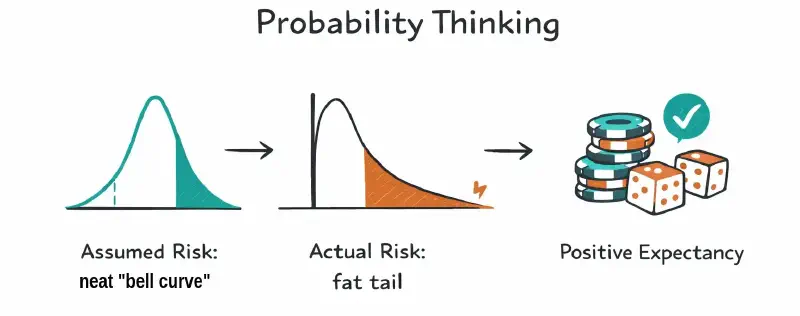
Financial markets do not follow a neat “bell curve” (Gaussian distribution). They follow fat-tailed distributions (as highlighted by Nassim Taleb). This means:
- Extreme events (“Black Swans”) happen far more often than standard models predict.
- A series of small, steady gains can be wiped out by a single, catastrophic loss.
- Risk is not volatility. Risk is the permanent loss of capital, often from an event your model said was “impossible.”
Implication for Traders: Your system must be robust not just to “normal” losses, but to market chaos. This fundamentally changes how you approach the next pillar.
2.2 From Prediction to Process: The Casino vs. The Gambler#
A professional poker player doesn’t know what the next card will be. They know the probabilities of their hand improving versus their opponent’s range. They manage their chip stack (risk) accordingly. They can have a losing night but still be a winning player over 1000 hands.
This is your model:
- You are the casino, not the gambler. The casino doesn’t predict which number roulette will hit; it knows the house edge guarantees profit over thousands of spins.
- Your “edge” is your slight statistical advantage when your Market Mastery (Pillar 1) identifies a high-probability setup.
- A single trade is meaningless. It’s a random sample. Your system’s validity is measured over a large sample size (50-100+ trades).
2.3 Abandoning Certainty: The “Thesis-Based” Trade#
Replace “This trade will win” with “Under these specific conditions, this trade has a positive expectancy.”
Every entry must be based on a falsifiable thesis:
- “Price is retesting a major liquidity pool on high volume. My thesis is this pool will act as support. This thesis is invalidated if price sustains a break below it on a closing basis.”
- “The market structure is bullish, and we are entering a pullback to a prior order block. My thesis is the trend will resume. This thesis is invalidated if price creates a lower high.”
This shifts your focus from P&L (which you can’t control) to process (which you can). A trade where your thesis was correct but you took a small loss is a good trade. A trade where you got lucky with a profit but your thesis was flawed is a bad trade.
Pillar 3: Risk Management – The Discipline of Survival#
If Market Mastery is your offensive strategy and Probability Thinking is your game plan, Risk Management is your defense and your logistics. It ensures you stay in the game. No amount of market insight matters if you are bankrupt.
3.1 The Prime Directive: Position Sizing#
This is the single most important technique in all of trading. Position sizing translates your probabilistic thinking into concrete action. It answers: “Given my edge and the current market uncertainty, how much should I risk?”
- The Percentage Risk Model: Never risk more than a fixed % of your current total trading capital on any single trade. 1% is standard for most; 0.5% is conservative and wise when learning.
- Example: With a $10,000 account and a 1% risk rule, you can lose $100 on this trade.
- If your stop-loss is 50 points away, your position size must be calculated so that a 50-point loss = $100.
- Volatility-Adjusted Sizing: Use tools like Average True Range (ATR) to size positions relative to current market noise. In a wildly volatile crypto market, your position size should be smaller than in a calm blue-chip stock for the same dollar risk. This prevents you from being stopped out by normal fluctuations.
3.2 Moving Beyond the Rigid Stop-Loss Trap#
For traders who understand fat tails (Pillar 2), a tight, rigid stop-loss can be a liability. It turns a temporary, volatile move into a permanent loss. The alternative is dynamic, intelligent risk control:
- The “Catastrophe” or “Thesis” Stop: Place your stop at a level that, if hit, conclusively proves your market thesis (Pillar 1) wrong. This is wider than a “tight” stop but is logically defensible. Your position size is then calculated based on this distance.
- Time-Based Exits: “If my thesis hasn’t started playing out in X bars/periods, I will exit.” This prevents tying up capital in dead trades.
- Volatility Bands: Use ATR to set a stop at
Entry ± (2.5 * ATR). This stop “breathes” with the market.
3.3 The Non-Negotiable Portfolio Rules#
Individual trade risk is only half the battle. You must manage your entire portfolio:
- Maximum Drawdown Limit: Set a hard, absolute rule. “If my total portfolio loses 10% from its peak value, I will stop all trading, reduce to minimum size, and reassess.” This is your circuit breaker.
- Leverage as a Risk Multiplier: Leverage does not increase your edge; it magnifies your gains and losses. Use it sparingly. In forex or crypto, 5:1 leverage is conservative; 100:1 is playing with fire.
- Correlation Awareness: Be wary of holding multiple positions that are likely to move together (e.g., multiple tech stocks, or Bitcoin and Ethereum). This is not diversification.
The Synthesis: How the 3 Pillars Work Together in Real Time#
Let’s walk through a live trading scenario to see the pillars interact.
Step 1: Market Mastery Informs the Thesis
- Context (Classical TA): EUR/USD is in a clear weekly uptrend, pulling back to a major Fibonacci level.
- Microstructure (Order Flow): The pullback is happening on low volume. A clear “Order Block” (a consolidation zone where prior buying occurred) sits just above the Fibonacci level.
- Thesis: “Price is likely to find support in the confluence zone of the Order Block and the 61.8% Fib. I will look for a bullish reversal signal here to re-join the trend. My thesis is invalidated if price slices through the Order Block and closes the day below it.”
Step 2: Probability Thinking Sets Expectations
- I know my edge (confluence trading) has a historical win rate of ~55% with an average risk-reward of 1:2.5.
- This means over 100 trades, I expect to win 55 and lose 45. My expectancy is positive.
- I accept that this specific trade could be a loss. My goal is to execute the process.
Step 3: Risk Management Executes the Plan
- My portfolio is $20,000. My max risk per trade is 0.75% = $150.
- My invalidation level (thesis stop) is 80 pips away from my planned entry.
- Position Size Calculation:
$150 / 80 pips = $1.875 per pip. - For EUR/USD, a standard lot is $10/pip. Therefore, I can trade 0.19 lots ($1.875 / $10). I round down to 0.18 lots.
- I place my entry. My stop is at the invalidation level. My target is 200 pips away (1:2.5 R:R).
- This trade risks $144 (0.18 lots * 80 pips * $10).
The Outcome is Secondary: Whether this trade wins or loses, I have succeeded. I applied mastery to find an edge, used probability to frame it correctly, and used risk management to ensure my survival. This is the repeatable process.
Common Traps & How to Avoid Them#
- Trap 1: Over-Investing in One Pillar. The indicator junkie (only Mastery), the rigid systems trader (only Probability), or the fearful under-trader (only Risk). Solution: Conduct weekly reviews of your trades. Are you ignoring one pillar?
- Trap 2: Mistaking Backtests for Reality. A perfect backtest is often “curve-fit” and fails in live markets (it ignores fat tails). Solution: Forward-test any strategy with tiny size in real market conditions.
- Trap 3: Scaling Up Too Fast. After a few wins, the temptation is to double your risk. This is when a fat-tail event strikes. Solution: Only increase position size based on increases in total capital, not on a winning streak.
- Trap 4: Chasing Guru Methodologies. Jumping from one “secret method” to another prevents you from developing your own synthesized framework. Solution: Pick a core approach and stick with it for at least 6 months while you learn its nuances.
Conclusion: Building Your Trading Framework#
Trading is not a destination; it’s a craft. You don’t “arrive”; you continuously refine your understanding of these three pillars.
Your Action Plan:
- Audit Your Current Approach. Which pillar is your strongest? Which is weakest?
- Study with Purpose. Focus your Market Mastery study on one market and two complementary theories (e.g., Order Flow + Classical TA).
- Reframe Your Journal. Log every trade not by P&L, but by: Thesis, Why Thesis Was Right/Wrong, Risk % Taken, Adherence to Plan.
- Implement the 1% Rule and Drawdown Limit. Make these non-negotiable starting today.
The market doesn’t reward intelligence alone. It rewards robustness. It rewards those who respect its power, understand its uncertainty, and have the discipline to protect themselves from its inevitable storms. Build your three pillars strong, and you build a career.
What pillar do you find most challenging? Share your thoughts and experiences in the comments below. For more deep dives into market structure and risk psychology, subscribe to the newsletter.